Trackline search (return) pattern
The Trackline search (return) pattern, also referred to as ‘Trackline Single-unit Return (TSR)’, is used when the only available information is the intended route of a vessel or aircraft. This type of search pattern is often used as an initial search effort due to speed that it can be planned and implemented.
SARTrackline search (return)
The Trackline search (return) pattern usually consists of 2 search legs, one on either side of the intended route. The search pattern will follow the intended route to one side and then return on the other side. The search legs will be parallel and be a specified distance (track spacing) apart, with the intended route in the center (i.e.: The intended route will be separated from the search legs by half the specified Track distance).
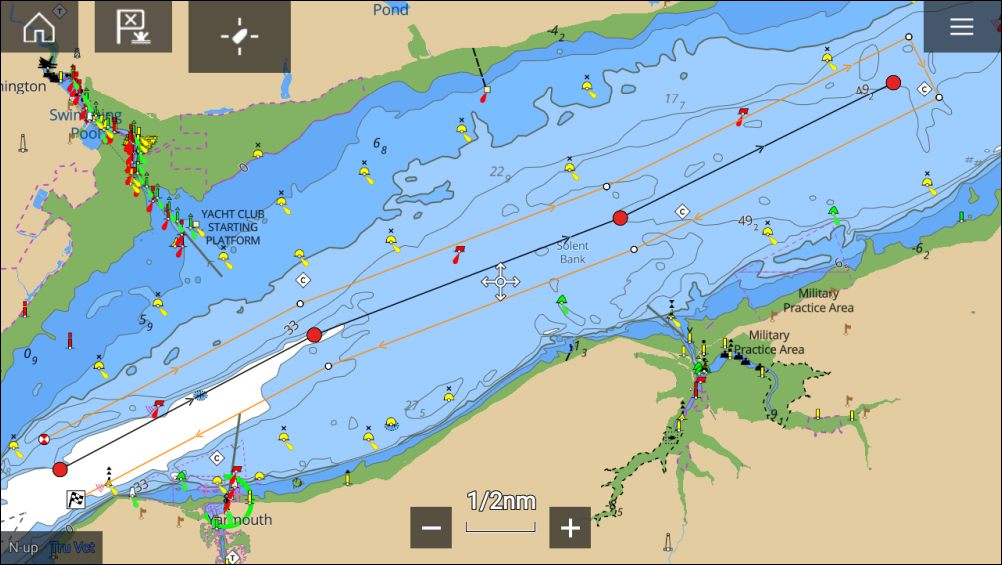
Figure 1. Example trackline search (return) pattern
The search pattern can also be configured to traverse the route more than twice, enabling a greater area to be searched on either side of the intended route.
Traversals are done in pairs so that the final search leg returns to the same end of the intended route that the search commenced. All search legs use the same track spacing.
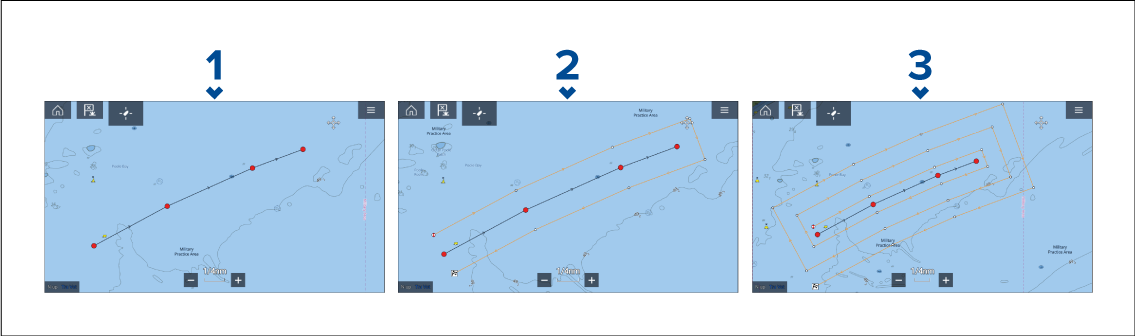
Figure 2. Traversal examples
Intended route
2 traversals (once per side)
6 traversals (three times per side)